Recording Everything Is Not the Same as Governing It: Avoiding Compliance Pitfalls in Pexip Deployments
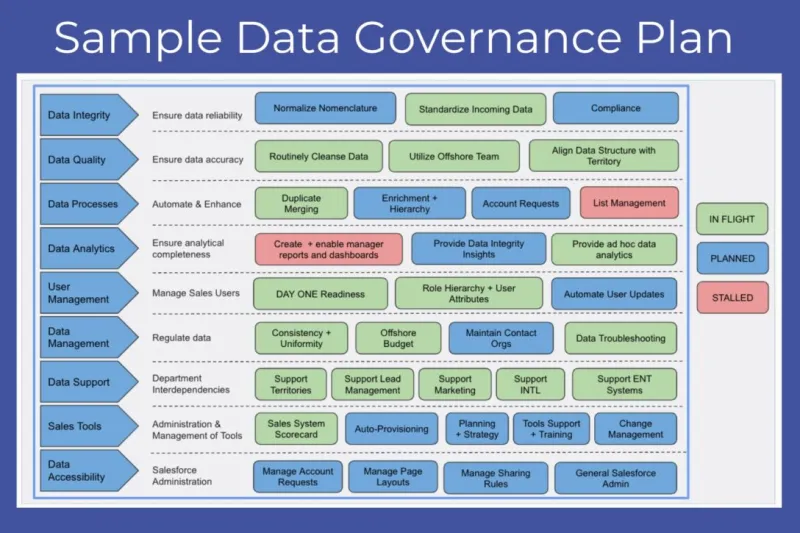
Photo: enterprise compliance data governance recording policy office meeting, via www.leandata.com
For IT leaders overseeing enterprise video infrastructure, the instinct to enable recording across a Pexip deployment often feels like a risk-reduction move. Executives want meeting documentation. Legal teams want evidence trails. Compliance officers want audit-ready artifacts. Pexip's native recording capabilities and integrations with third-party recording platforms make activation relatively simple—sometimes deceptively so.
The problem is not the recording itself. The problem is what accumulates afterward, and what happens when no one is actively governing it.
Organizations that enable recording without a corresponding governance framework frequently discover, months or years later, that they have created a new category of liability rather than resolved an existing one. Storage costs spiral. Retention schedules go unenforced. Recordings that should have been deleted persist indefinitely—and recordings that should have been preserved are overwritten. When litigation or regulatory inquiry arrives, the resulting discovery process can be far more damaging than the absence of recordings ever would have been.
The False Security of Broad Recording Enablement
Pexip supports recording through multiple pathways: native recording nodes, integrations with platforms such as Verint and NICE, and direct streaming to external storage via RTMP or similar protocols. Each pathway has its own configuration requirements and its own set of administrative touchpoints.
When organizations enable recording broadly—applying it to all virtual meeting rooms, all scheduled conferences, or all external participant calls—they often do so without modeling the downstream implications. A mid-sized enterprise running several hundred Pexip-hosted meetings per week can generate terabytes of recorded content monthly. Without automatic lifecycle management, that content accumulates indefinitely on whatever storage tier was provisioned at deployment.
More critically, broad enablement creates an implicit expectation that recordings are complete and accurate. If a participant joins late, drops, or reconnects, the recording may be fragmented. If a network interruption affected a node during capture, the resulting file may be corrupted or truncated. Relying on recordings as authoritative compliance artifacts without validating their integrity is an assumption that can fail in a regulatory or legal context.
Retention Policy Failures Are More Common Than They Appear
Most compliance frameworks—including those governing financial services, healthcare, and federal contracting—specify retention windows. FINRA requires certain communications records to be retained for three to seven years. HIPAA-covered entities have their own documentation obligations. State-level privacy regulations add further complexity, particularly for organizations operating across multiple US jurisdictions.
Pexip itself does not enforce retention policy at the content layer. That responsibility belongs to the storage platform, the recording integration, or the organization's own data lifecycle management tooling. If those systems are not configured correctly—or if configuration drifts over time due to personnel changes or infrastructure migrations—retention schedules fail silently. Recordings that should be deleted remain accessible. Recordings that should be preserved are purged.
IT teams should treat retention enforcement as an active, auditable process rather than a one-time configuration task. Quarterly reviews of retention policy alignment, storage tier assignments, and deletion confirmation logs are a minimum baseline for organizations with formal compliance obligations.
The Legal Exposure No One Anticipates
Perhaps the least intuitive risk in enterprise recording governance is the legal exposure created by over-retention. In US civil litigation, electronic discovery obligations extend to any data that is reasonably accessible and potentially relevant to a dispute. Recordings that have not been deleted according to a defensible retention schedule may be subject to discovery—even if the organization never intended them to serve as evidence.
This dynamic creates a practical paradox: organizations that record everything and retain it indefinitely may face broader discovery obligations than organizations that record selectively under a documented policy and delete according to schedule. The existence of a retention policy is not itself a shield, but the absence of one—combined with large volumes of retained recordings—can significantly expand litigation exposure.
Legal counsel should be involved in the design of any enterprise-wide recording policy. IT teams are well-positioned to implement technical controls, but the legal and regulatory dimensions of retention require input that falls outside the scope of infrastructure management.
Building a Governance Framework That Scales
A functional governance framework for Pexip recording does not need to be elaborate, but it does need to be explicit. The following components represent a practical baseline for US enterprise environments.
Scope Definition: Not every meeting room or conference type requires recording. Define which virtual meeting rooms have recording enabled by default, which require participant consent notifications, and which should never be recorded due to content sensitivity. Pexip's policy management capabilities allow recording behavior to be configured at the VMR level, which supports granular scope control.
Consent and Notification Compliance: Several US states require all-party consent for recorded communications. Pexip supports customizable participant join messages and can be configured to announce recording status at the start of a session. Ensure that notification language aligns with the most restrictive applicable state law for your participant base, and document that configuration as part of your compliance record.
Storage Architecture and Tiering: Designate a primary storage destination for recordings and implement automatic tiering to cold or archival storage after a defined active period. Avoid storing all recordings on high-performance storage tiers indefinitely—this drives unnecessary cost and complicates lifecycle management.
Automated Lifecycle Enforcement: Integrate your recording storage platform with a data lifecycle management tool that enforces deletion schedules automatically and generates deletion confirmation logs. Manual deletion processes are error-prone and do not produce the audit trail that regulatory review may require.
Integrity Validation: For recordings that will serve as compliance artifacts, implement a checksum or hash verification process at the time of capture and at defined intervals thereafter. This provides defensible evidence that a recording has not been altered since creation.
Access Controls and Audit Logging: Restrict access to recorded content based on role and business need. Pexip's management interface supports role-based access controls, but access to the underlying storage platform must be governed separately. Maintain logs of who accessed which recordings and when.
Periodic Policy Review: Assign ownership of the recording governance framework to a named individual or team. Schedule formal reviews at least annually, and trigger ad hoc reviews when regulatory requirements change, personnel transitions affect key roles, or infrastructure migrations alter storage architecture.
Governance as Infrastructure
The organizations that manage Pexip recording capabilities most effectively treat governance not as a compliance checkbox but as a component of their infrastructure design. Recording policies are documented in the same way that network topology and failover procedures are documented. Retention schedules are enforced by automated systems rather than manual processes. Legal and IT stakeholders collaborate on policy design rather than operating in separate tracks.
This posture does not eliminate risk—no governance framework does. But it converts an unmanaged accumulation of recorded content into a defensible, auditable system that serves its intended purpose without generating unintended liability.
The capability to record is easy to enable in Pexip. The discipline to govern what you capture is what separates a compliance asset from a compliance problem.